DMAIC is the most widely taught problem-solving framework in industry. It is also one of the most commonly mis-applied. This article explains why a Thought Map driven, induction-deduction loop — what we call iterative learning — produces faster and more durable solutions on hard engineering and manufacturing problems, and how the two approaches fit together.
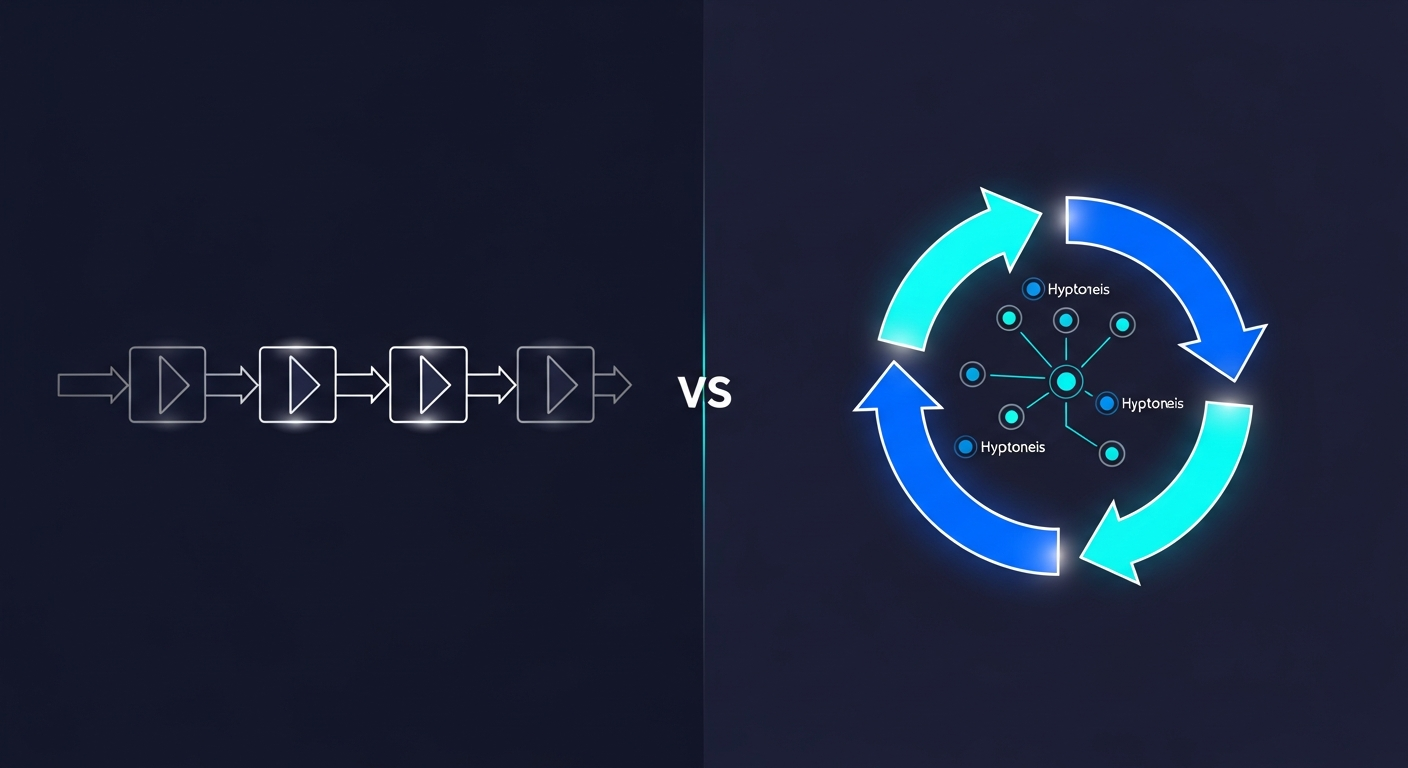
The DMAIC promise
DMAIC — Define, Measure, Analyze, Improve, Control — was popularised by Motorola and General Electric in the 1980s and 1990s as a structured way to drive process improvement. As a project management shell, it is excellent. It tells teams how to charter the work, gate the phases, and report progress to leadership. Tens of thousands of Black Belt projects have been completed inside DMAIC, and the financial savings claimed by major deployments are real.
Where DMAIC quietly breaks
The trouble starts when DMAIC is treated as an epistemic framework — a description of how knowledge about the problem is supposed to accrue. Three failure modes show up again and again:
- Premature measurement. A team marches into "Measure" before anyone has written down the real questions. Data is collected on whatever is easy to measure, not on what would change the team's mind.
- Analyze as a destination. "Analyze" is framed as the place where the answer arrives. In practice, every honest analysis surfaces three new questions, and the project plan has no slot for them.
- Improve before understanding. The gate from "Analyze" to "Improve" rewards committing to a solution. Teams ship a change to keep the project on schedule, then re-open the same problem six months later under a different name.
These are not failures of the people doing the work. They are failures of a framework that promises sequential certainty on problems that demand iterative discovery.
What hard problems actually require
Hard engineering problems — yield walls, intermittent defects, marginal capability, scale-up variation — share three features:
- The list of candidate causes is large and only partly known at the start.
- The measurement system that you would use to settle the question is often itself suspect.
- Many candidate causes are plausible; few are testable with the resources at hand.
These problems are solved by repeatedly asking "what would I have to see to change my mind?" — and then designing the smallest experiment that would produce that evidence. That is induction (forming the hypothesis) and deduction (deriving a refutable consequence) operating as a loop, not a phase.
The iterative learning loop
The loop we recommend has four moves, repeated as many times as the problem demands:
- Map your assumptions. Write the candidate causes and hypotheses on a Thought Map. Mark which ones are load-bearing — the ones the rest of the investigation depends on.
- Choose the cheapest decisive test. For each load-bearing assumption, ask: what is the smallest piece of evidence that would force me to abandon this hypothesis? Pick the cheapest such test that is available right now.
- Run the test rigorously. Use the appropriate statistical tool — Measurement System Evaluation if the gauge is in doubt, Components of Variance if you do not know where the variation lives, Design of Experiments if you need to separate effects. Run the test with proper randomisation and replication. Statistical rigour is non-negotiable inside the loop.
- Update the map. Mark which branches survived, which are dead, and which new questions opened up. Repeat from step 1 against the new map.
The map is the durable artifact. The phases are not.

Side by side
| Dimension | Traditional DMAIC | Iterative Learning |
|---|---|---|
| Primary unit of progress | Phase gate completed | Hypothesis falsified or confirmed |
| Default cadence | Weeks per phase | Days per cycle |
| Treatment of new questions mid-project | Deferred to a future project | Added directly to the Thought Map |
| Role of the measurement system | Verified once in "Measure" | Re-tested whenever the question changes |
| Role of DOE | Concentrated in "Improve" | Used whenever a hypothesis needs to be separated from a confounder |
| Risk of solution lock-in | High — gates reward commitment | Low — solutions are conclusions of the loop, not deliverables of a phase |
| Best suited to | Well-understood processes, governance reporting, certification audiences | Novel processes, ambiguous defects, capability ceilings, scale-up |
You do not have to choose
Iterative learning is not anti-DMAIC. The two operate at different layers:
- DMAIC is a useful outer shell for stakeholders, charters, and savings reporting. Many large organisations require it. Keep it where it adds value.
- Iterative learning is the inner engine that actually generates knowledge. It lives inside what DMAIC calls "Analyze" and "Improve" — and quietly does most of the work that gets credited to "Improve" alone.
If your organisation requires DMAIC-shaped deliverables, you can still run an iterative learning loop underneath; you just translate the final state of the Thought Map into the phase artifacts at the end. The work itself does not change.
What this looks like in Ops Excellence
The platform is built around the loop, not the phases:
- Every project starts with a Thought Map. Assumptions and hypotheses are first-class objects.
- MSE, COV, and DOE tools attach to specific hypotheses on the map and record their results there.
- A multi-agent AI assistant guides each cycle: it pressure-tests the wording of hypotheses, suggests which test would be most decisive next, and refuses to skip the measurement-system check before a costly experiment.
- The Thought Map is the project narrative. There are no separate D, M, A, I, C documents to maintain unless your organisation explicitly requires them.
The shorter version
DMAIC tells you how to manage the project. Iterative learning tells you how to solve the problem. The two are not the same activity. Confusing them is the most common reason that polished Six Sigma deployments produce mediocre engineering outcomes.
Start a project and run a single iterative learning cycle on a problem you already think you understand. If the Thought Map at the end looks the same as the one you would have drawn at the start, you have learned something important. If it does not, you have learned something more important.